

Finding Mutti when she doesn't want to be found, and watching the road she leaves on long after the white van disappears
Scenes from my childhood

‘Thou art thy mother’s glass, and she in thee/Calls back the lovely April of her prime;’ —William Shakespeare, Sonnet 3
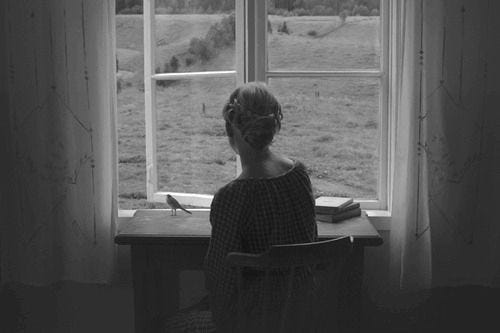
Mutti, where are you?
I want her to read to me, even though I can read to myself. I like to sit with her, lean into her soft side, hear her do the voices.
I want her to play with me, lay a small table with tiny cups and saucers and place the dolls in seats around it, pour real tea for our tea.
I want to know my mom’s here, somewhere, in this house with me. I want to be sure I’m not alone.
I’m five, six, seven years old—I’ve started school and she’s started writing her book. We’ve started these big new things together.
I call down the hallway from my bedroom towards the kitchen, “Mutti, where are you?”
No answer.
Has she gone out? Could she be picking up one of my older sisters from a friend’s house? Could she have announced she was leaving by the back door, and I didn’t hear because I was playing in my room?
I check the kitchen—she’s not cooking at the stove or chopping at the counter or washing dishes in the sink. It’s just the refrigerator humming and the tap dripping and the afternoon sun streaming through the window and making a square of light on the brown linoleum floor.
I walk across the dining room and open her bedroom door. I check in there and then I check her bathroom—empty.
I check her deep closet—maybe she’s getting dressed in there. No.
I walk down the steep staircase to the basement where she does laundry, but all I see is the dim outline of the washing machine and dryer, all I smell is the musty scent of mildew.
Back upstairs, I check the living room—and I find her. As I’ve been calling and calling, she’s been right here. She’s been sitting at her desk in a dark corner of the living room, which is right next to the kitchen. She must have heard me calling—why didn’t she answer?
Maybe she didn’t answer because her head is down on her desk, like when kids are bad or rowdy at school, and the teacher says, ‘put your head down’. That’s how she is, her head tucked into her crossed arms on her desk.
I stop in the doorway and I’m quiet now because something’s not right. She’s not asleep exactly, but she’s not here for me right now. She’s hiding, even from her own self maybe, and she doesn’t want to be found.
“Mutti!” I call out anyway, even though I guess she probably wants me to stay quiet.
I can’t. I need her.
When she lifts her head, she looks tired and a little sad. But when she sees it’s me, her face brightens and she calls out affectionately, ‘Oh, Mousie! Here I am.’
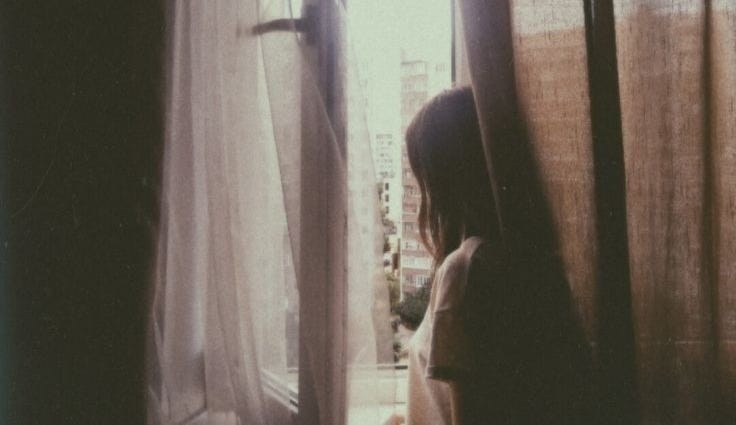
I stand before the picture window at the front of my house, watching my mother walk down the path that leads from our front door to the driveway. A white van waits for her. In the driving seat sits my Uncle Peter, her younger brother.
She walks around the front of the van, looking thinner, smaller, more fragile than I’m used to, her fingers like chicken bones pulling at the door handle.
She steps up into the van and takes the seat next to her brother. The car door slams with a thud and she nods at him, I’m ready. He looks back over his shoulder and reverses out of our driveway.
I’m nearly twelve years old.
I stay. I watch. It’s springtime: the crabapple tree at the center of our front yard is blooming pink-and-white but the sky is grey, the air is chilly, the ground is wet from recent rain.
It’s April in Boston; it might still snow.
Last year snow fell on my birthday, the last day of the month, blanketing our flowering forsythia bushes so the bouquet of yellow blooms my father cut me dripped puddles of water on the dining table.
She’ll be home for my twelfth birthday, she says. Some tests, some treatments—she’ll be home in two weeks.
She says it like it’s no time at all but to me two weeks sounds long. She’s never away from home without us, not even during the day while we’re at school, unless she’s at the town library writing, and that’s a recent thing.
She’s usually home when we’re home from school and she’s always home before dinnertime, chopping and stirring and frying in the kitchen to prepare our evening meal.
Who will cook tonight? What will we eat? I should wonder, but I don’t.
I stand at the window, watching the white van back out of our driveway. It pauses on our two-lane countryish road, before pushing off toward an unfamiliar destination. She’s going to the hospital. Which one? Where? I have no idea. Boston, probably. The city.
Through the half-bare wall of trees between me and the road, I see my mother in her brother’s van: she’s facing forward, looking at where she’s going—not looking back at me, our house, our yard, her life.
She’s just going to the hospital for two weeks.
Do I know she’s not coming back? Do I know it’s the last time I’ll see my mother, while she still looks like my mother? Do I know I’ll be writing about this moment when I’m fifty-one years old?
Maybe some premonition that I’ll want to remember this moment glues my feet to the floor before our picture window, so I stand there numb and silent, memorizing each detail—so I stand there watching, watching, watching the road long after the white van disappears to who knows where.
Maybe I’m just feeling the anxiety every child feels when their mother leaves the house.
Or maybe I’m making some impossible deal with myself: if I don’t move from this spot, she didn’t really leave me.
These anxious scence from Sylvia's childhood in suburban Boston contrasts with her mother Karin's traumatic childhoon in wartime Germany.